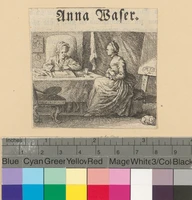
In Search of Swiss Female Artists
If women had the opportunity to develop and showcase their talents, and could enjoy the same benefits of education as men do, we would have far more examples of outstanding female artists in the history of art than we do today.
Johann Caspar Füssli, entry on Anna Waser, in: “Geschichte der besten Künstler in der Schweitz,” Volume 3, Zurich 1770, p. 5
This assessment of the situation of female artists in Switzerland in the 18th century was recorded by Johann Caspar Füssli in his “Geschichte der besten Künstler in der Schweitz” from 1770. In doing so, Füssli—adopting a stance that was critical for his time—explains one of the reasons why we encounter so few female artists in Swiss art history: In most cases, women at that time were denied an education beyond their domestic duties. Without access to instruction in various artistic techniques, it was very difficult for them to acquire the necessary basic skills and create works that would attract the interest of wealthy patrons and clients.
The fact that the underrepresentation of women in art history, as Füssli argues, is due not to a lack of talent but to the conditions surrounding them is also demonstrated by one of the well-known exceptions: Anna Waser. Born in Zurich in 1678, the artist was encouraged by her father from childhood onward, as he had recognized her great talent for drawing and painting. Thanks to his support, Waser received instruction from renowned Swiss artists and later worked as a successful portraitist and miniature painter both in and outside her homeland.
https://blog.nationalmuseum.ch/2023/01/Waser and Merian: Two Female Artists of the Baroque/ [November 19, 2025]; Linda Nochlin, Why Have There Been No Great Women Artists?, in: ARTnews 69, No. 9 (January 1971): pp. 22–39, pp. 67–71
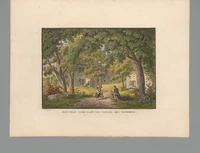
Jean-Jacques Rousseau: A Promoter of Swiss Tourism, but Not a Champion of Women's Rights
With his epistolary novel "Julie, or The New Heloise", published in 1761, the Swiss-French writer, philosopher, and educator Jean-Jacques Rousseau (1712–1778) achieved great success: The novel is one of the most widely read books of the 18th century. The story revolves around the love affair between the young noblewoman Julie and her tutor Saint-Preux, a relationship that has no future due to the social class differences between the two protagonists. The story is set in the area around Lake Geneva and the small town of Vevey. It is thanks to Rousseau’s idealized depiction of the local landscape that the region became a popular Swiss destination, where travelers flocked in droves to retrace Rousseau’s footsteps.
Another theme of the novel is the concept of what constitutes a virtuous romantic relationship. In the story, the main character, Julie, opts for a marriage of convenience with the wealthy Wolmar and thus becomes the virtuous heroine of the book. Through her character, Rousseau also makes it clear that, in his view, a woman is at the service of her husband and is primarily responsible for the household. Rousseau elaborates on this patriarchal view of women in his educational novel "Emile", published in 1762:
The entire education of women must therefore be oriented toward men. To please them, to be useful to them, to be loved and honored by them, to raise them in their youth, to care for them in adulthood, to advise them, to comfort them, to make their lives pleasant and delightful: These are the duties of women in all ages, and this must be taught to them from childhood onward.
Jean-Jacques Rousseau, Emile, ou, De l'éducation, Amsterdam 1762, Volume four, Book V, p. 30
Katy Hessel, The Story of Art without Men. London 2022, p. 54
Women Artists in Nature – Was That Possible?
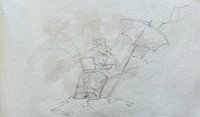
The Kleinmeister were known in particular for their landscape views, which they had drawn "from nature." To create these paintings, the artists – equipped with a sketchbook, pencil, and brush—often spent days on end in the mountains or traveling long distances. The sight of a woman sketching in nature, as seen here, was extremely rare around 1800, as it contradicted the prevailing social notions of women’s roles at the time. This is also reflected in the proportion of female artists in the research portal of "Images of Switzerland Online": Out of 599 artists, 8 are women (for 314 individuals, gender is listed as "unidentified"). This means that only 1.32% of the total number of recorded and identified artists are female.
Those female artists known from the circle of the Kleinmeister could often – though not always – count on a supportive family environment. Rose d’Ostervald (1795–1831), for example, was encouraged by her father and later became one of the most successful Swiss landscape painters. This depiction of a female artist sitting on a rock while working outdoors comes from one of her sketchbooks – perhaps Rose d’Ostervald had portrayed herself here. In this display case, we follow in the footsteps of Rose as well as the artists Louise-Elisabeth Vigée Lebrun, Nanette Bleuler, Franziska Möllinger, Clara Reinhard, and Elise Wysard-Füchslin, exploring their works, their social backgrounds, and their connections to the Kleinmeister.
https://bso.swissartresearch.net/resource/Default:Start [March 13, 2026]
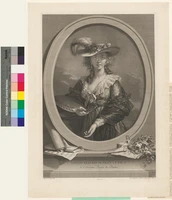
A French Artist in Switzerland
Also during her childhood, the Frenchwoman Louise-Elisabeth Vigée Lebrun was introduced to painting by her father, himself a pastel artist. However, since her father died at an early age, the young artist taught herself much of what she knew. After initial successes as a portrait painter in Paris, Louise-Elisabeth married the art dealer Jean-Baptiste-Pierre Le Brun (1748–1813), who gave her access to Parisian high society. Even the French queen, Marie-Antoinette, was enthusiastic about the young painter and commissioned several portraits from her.
Due to her close ties to the royal family, Louise-Elisabeth Vigée Lebrun was forced into exile during the French Revolution. She spent a total of 12 years at various royal and aristocratic courts, including Rome, St. Petersburg, and Berlin. Through her travels, the artist became famous throughout Europe. Even after she was able to return to Paris, she undertook further journeys that took her to London in 1802 and to Switzerland for the first time in 1808. In Switzerland, she had her sights set on a very specific event: the Alpine Herdsmen’s Festival in Unspunnen. In the Bernese Oberland, the Frenchwoman stayed with the Kleinmeister Franz Nikolaus König (1765–1832):
That’s how I ended up in Unterseen, near Underlach. I knew that Mr. König had arranged lodging for me, so I went to see him. I indeed found a charming room, a brand-new bed with green curtains. At Mr. König’s house, there was a communal table for all distinguished guests who had come for the Shepherds’ Festival.
Louise-Elisabeth Vigée Le Brun, Souvenirs de Madame le Brun, Voyage en Suisse en 1808 et 1809, Letter IX. Undersée; la fête des bergers, Paris 2015, p. 123
Louise-Élisabeth Vigée Le Brun and Patrick Weiller (eds.), Souvenirs de Madame Louise-Élisabeth Vigée-Lebrun. Paris 2015
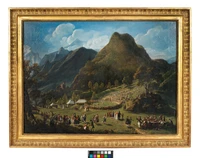
"La Fête des Bergers Suisses à Unspunnen"
The next day, the weather – which had worried us the night before – cleared up by nine o’clock. Everyone set off in all directions to make their way to the festival grounds; I arrived at half past ten, and right at the entrance I was captivated by the most enchanting sight: Imagine a green amphitheater, crowned by a high mountain with lush vegetation; further down, to the left, grassy seating tiers, shaded and interspersed with slender, graceful trees; halfway up, slightly elevated, stands a ruin called Unspunnen [...]. When I arrived, these places were teeming with people; the radiant sun illuminated groups of farmers from various cantons sitting on the hill [...].
Louise-Elisabeth Vigée Le Brun, Souvenirs de Madame le Brun, Voyage en Suisse en 1808 et 1809, Letter IX. Undersée; la fête des bergers, Paris 2015, p. 125
In her "Souvenirs", published in 1835 after her death, Louise-Elisabeth Vigée Lebrun recounts, travel accounts in the form of letters to her friends, about the Alpine herdsmen’s festival in Unspunnen and its scenic backdrop. She captured both in a painting titled "La Fête des Bergers Suisses à Unspunnen", which she created in her Paris studio after her trip. In her studio, the artist reworked the sketches she had made on site so that the landscape appears less lifelike and instead serves as an imposing, arena-like stage for the Alpine Shepherds’ Festival. With a few exceptions, the festival’s audience is dressed in traditional Swiss costumes.
Photo: © Kunstmuseum Bern
Sandor Kuthy, Elisabeth Louise Vigée-Lebrun und das Alphirtenfest in Unspunnen, in: Journal of Swiss Archaeology and Art History, 1976, Vol. 33, No. 2, pp. 158–171
Women as Subjects in the Works of the Kleinmeister: Images of Traditional Costumes
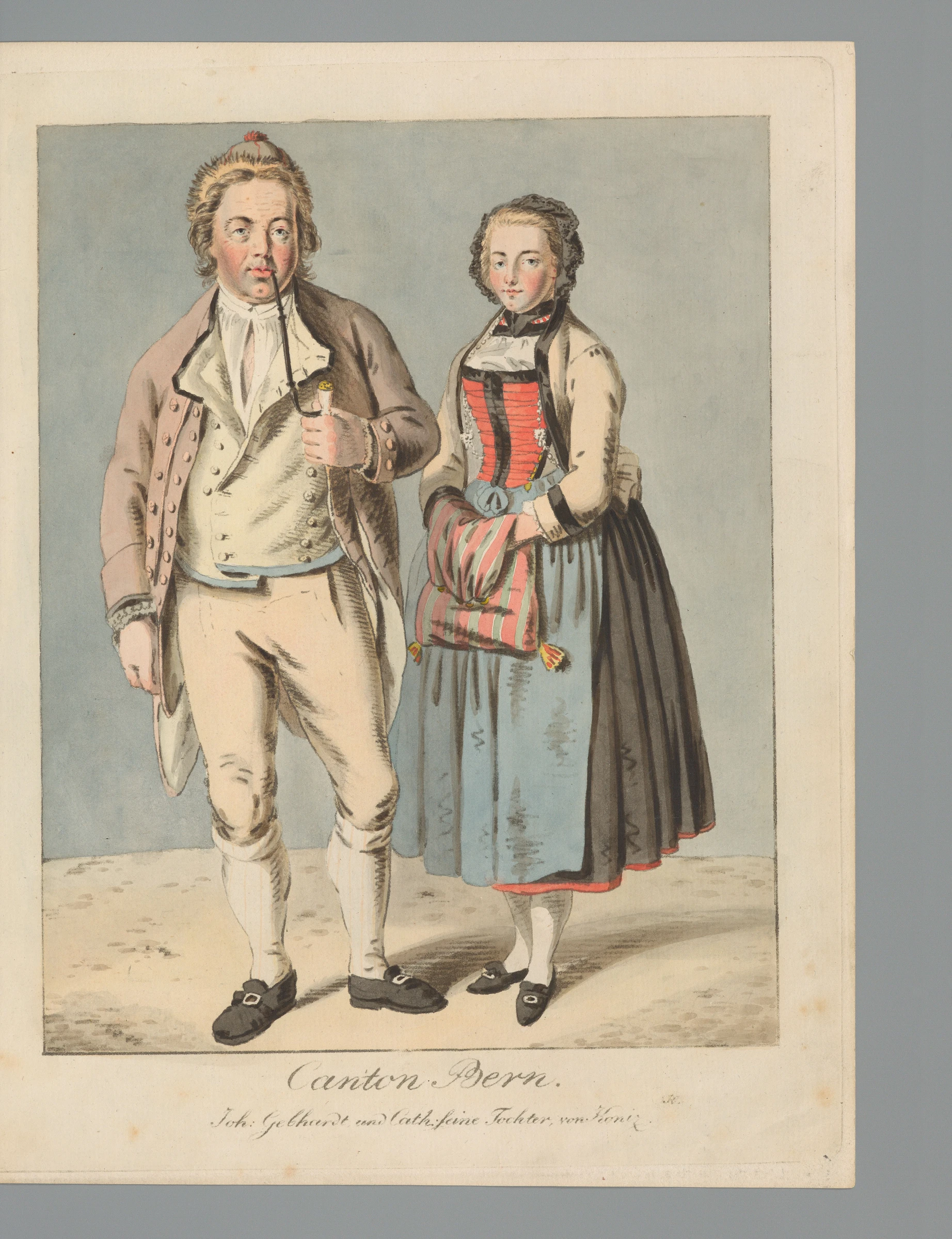
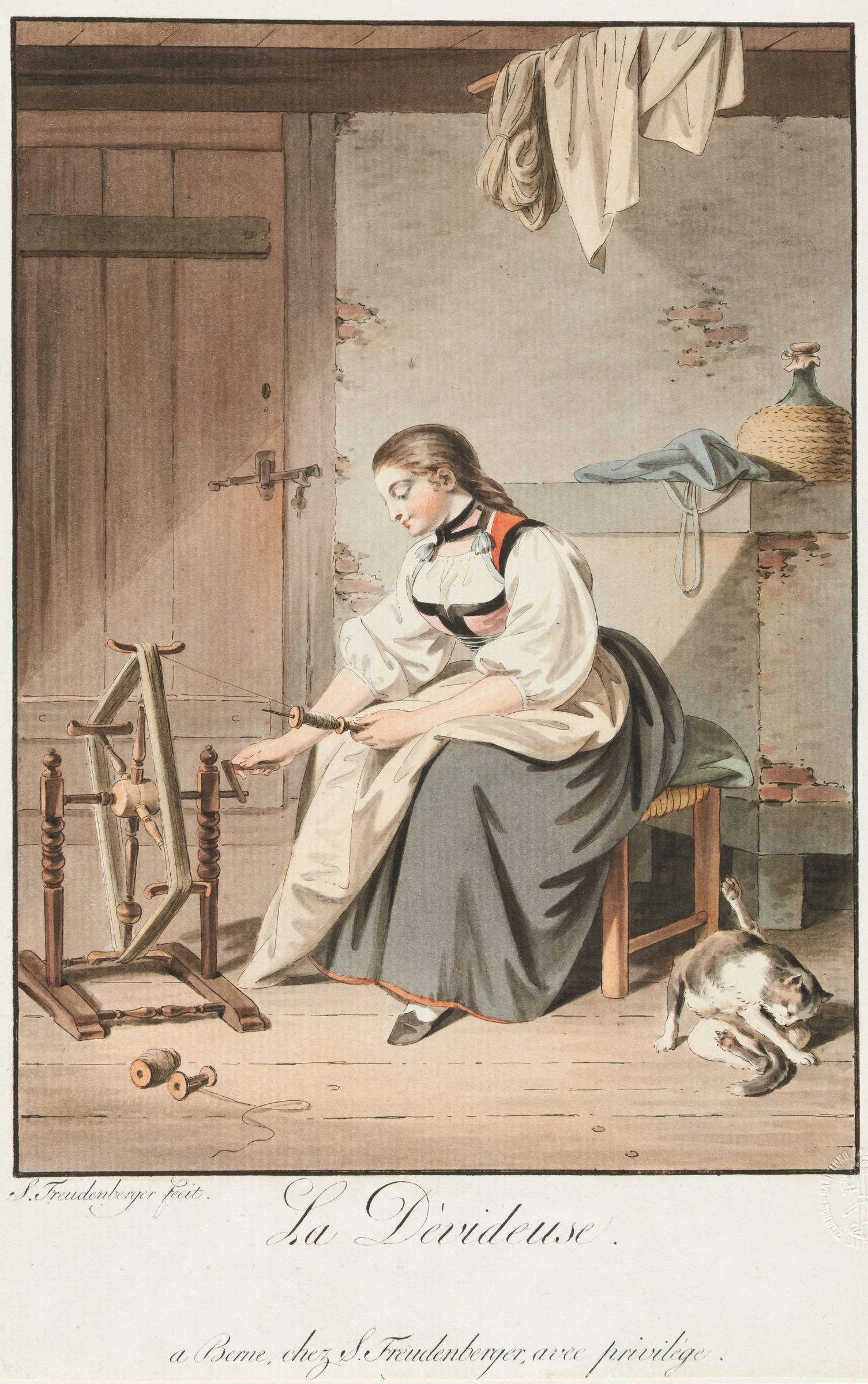
Numerous artists associated with the Kleinmeister movement also devoted themselves to depicting Swiss traditional costumes. The great variety of traditional garments, which differed from region to region, was understood at the time as an expression of the distinctive characteristics of the local population. At the same time, these traditional costumes also served as a symbol of Switzerland’s rural, nature-oriented population—an idealized notion that was very popular in Enlightenment thought. The engravings of traditional costumes by Franz Nikolaus König, based on models by the portrait painter Josef Reinhard (1749–1827) are among the most successful motifs in the genre.
Reinhard’s depictions are characterized by a high degree of realism—in contrast to the theatrical and melancholic traditional costume portraits by the Bernese artist Sigmund Freundenberger (1745–1801), whose depictions of women in traditional dress sometimes take on an erotic quality. How can one recognize these different approaches when comparing the two depictions of Bernese traditional dress by Reinhard and Freundenberger?
Clara Reinhard: A Masterful Illustrator
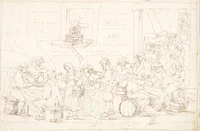
Various encyclopedias of artists indicate that Josef Reinhard’s daughter, Clara Reinhard (1777–1848), worked alongside him. A collection of 348 pen-and-ink drawings held by the Lucerne Artists’ Society (Kunstmuseum Luzern) demonstrates that, in her work around 1795, Clara Reinhard drew inspiration from both her father’s artistic style and that of Freudenberger – and, against this backdrop, developed her own distinctive approach to depicting genre scenes.
Characteristic of Clara Reinhard’s very free and confident pen-and-ink drawings are unvarnished depictions of peasant life. In this drawing, men and women in simple clothing are shown in a lively jumble. The figures are arranged as if they were seated at an elegant banquet – except that this banquet seems to extend all the way into the rustic kitchen, where cooking is in full swing. Such stage-like visual compositions can also be found in the oeuvre of Sigmund Freudenberger and stem from his training in the works of the French painter Jean-Baptiste Greuze (1725–1805).
Photo: © Kunstmuseum Luzern
Sylvia Rüttimann, "Clara Reinhard, die Tochter des Josef Reinhard". Eine Luzerner Zeichnerin am Übergang zum 19. Jahrhundert, in: Christoph Lichtin (ed.), Josef Reinhard 1749-1824: Trachten, Porträts, Menschenbilder. Bern 2005, pp. 157–178
Clara Reinhard: Intimate Insights
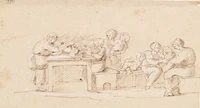
Another thematic focus of Clara Reinhard’s work was on areas of activity that were specifically perceived as women’s responsibilities at the time. As art historical research has shown, female artists have dealt with scenes such as personal hygiene, childcare, and housework with striking frequency. Considering that women in the 18th and 19th centuries were, in most cases, denied an education and that their primary sphere of activity was the world of the household, this is hardly surprising. Portrait art was also one of the areas that was long considered "appropriate" for female artists and where they more frequently received recognition for their work.
In this drawing, Clara Reinhard chose a scene that most of her contemporaries would likely have avoided: A group of women caring for small children, one of whom appears to be getting dressed or having a diaper changed.
Photo: © Kunstmuseum Luzern
Katy Hessel, The Story of Art without Men. London 2022, p. 18
Female Artists at the Bleuler School of Painting
From a report published in 1803 by an anonymous visitor to the Rhine Falls, we learn that Johann Heinrich Bleuler (1758–1823) ran an art school at Laufen Castle. There, young men as well as young women were taught various artistic techniques:
A great many young men and women aged 9 – 20 receive instruction here; where, so to speak, a small academy has been established, where engraving tools, etching needles, drawings, and paintings – in watercolors and oil paints – are practiced, and printing techniques – in short, everything necessary for a livelihood – are brought together. Mr. Bleuler, as the director, teaches his children various aspects of this art; the two oldest – a 14-year-old boy and a 19-year-old girl – create paintings that sell for 4 to 5 louis d’or […].
Anonymous, Nachrichten eines Reisenden, in: Zürcherische Freitagszeitung, February 25, 1803, p. 4
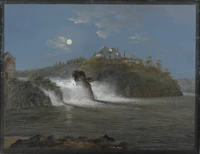
The children of Johann Heinrich Bleuler described here are presumably Johann Heinrich Bleuler the Younger (1787–1857) and Nanette Bleuler (1783–1851), the adopted daughter of Johann Heinrich Bleuler the Elder. While numerous works by Johann Heinrich Bleuler the Younger– who became a painter and publisher in his own right – have survived, we know of only very few signed works by Nanette Bleuler. However, her gouache of the Rhine Falls in the moonlight at night, which is preserved at the Museum zu Allerheiligen in Schaffhausen, is an important testament to her artistic abilities.
Photo: © Museum zu Allerheiligen Schaffhausen
Robert Pfaff, Die Bleuler Malschule auf Schloss Laufen am Rheinfall. Das Album »Malerische Reise rund um den Rheinfall«, Neuhausen am Rhein 1986, p. 24
A Glimpse into the Kleinmeisters's Studio
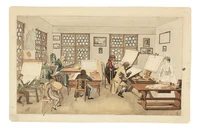
A drawing by Gabriel Lory père (1763–1840) depicts a scene similar to that at the Bleuler School of Painting: In a colorist’s studio, several young men are bent over their work tables. In front of two of them lie copper plates, which the two artists – who appear somewhat older – are working on with a graver. In front of the other young men lie sheets of white paper: Their painting supplies tell us that they are in the process of coloring printed sheets based on existing templates – since Gabriel Lory père’s drawing is unfinished, we have to imagine this.
Only one woman appears in the picture: In the lower right corner of the picture, she is rolling out dough on a separate table. This is an indication that the coloring of "Helvetica" was often done as work from home, i.e., at home, by family members and employees.
Photo: © Kunstmuseum Bern
Marie-Louise Schaller, Annäherung an die Natur. Schweizer Kleinmeister in Bern, 1750–1800, Bern 1990, pp. 255–259
Women as Colorists
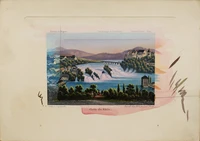
Gabriel Lory père’s account might give the impression that only men were involved in coloring Swiss landscapes and depictions of traditional costumes. On the contrary, there is evidence that women also frequently worked as colorists. However, since this work was considered to have less artistic value than drawing or engraving, colorists – both men and women – did not sign their works; thus, women’s participation in this work is known only from historical sources.
From the Neuchâtel cartographer and publisher Jean-Frédéric d’Ostervald (1773–1850), we learn, for example, that his daughters Rose, Pauline and Sophie were involved in coloring prints for his publication, which featured depictions of Swiss traditional costumes:
This is a little pastime that will keep my daughters occupied when they wish to engage in coloring.
Jean-Frédéric d’Ostervald to Maximilien de Meuron, Archives de l’État de Neuchâtel, MEURON MAXIMILIEN DE-52/01, Letter dated April 1, 1821, fol. 4r
Also in the art publishing house of the Zurich artist and publisher Johann Rudolf Dikenmann (1793–1883), his two daughters, Anna (b. 1819) and Louise (b. 1840), worked as colorists. Coloring artists were given sample sheets like the one shown here as templates to color the views according to a standardized scheme.
Lucas Wüthrich, R. Dikenmann. Souvenir de Suisse, Aarau 1984, p. 5
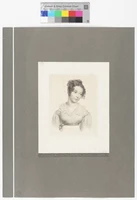
Rose d'Ostervald: Training within the Network of Ostervald
Rose d'Ostervald was born in 1795 as the eldest of four daughters of Rose-Marie Alexandrine d'Ivernois (1774–1861) and Jean-Frédéric d'Ostervald (1773–1850) in Neuchâtel. As a result, Rose d’Ostervald was fortunate enough to grow up in a socially well-to-do, intellectual, and artistic environment that enabled her to pursue a career as an artist. From a very early age, her father supported her artistic ambitions and arranged for her to be taught by his artist friends Maximilien de Meuron, Gabriel Lory fils, and Friedrich Wilhelm Moritz. Rose also worked outdoors with her teachers – an opportunity that was not available to many female artists at the time. Her father, Jean-Frédéric d’Ostervald, wrote about this in a letter to Maximilien de Meuron:
The advice you gave my daughter has given me great pleasure; she has been working from nature this summer, sometimes with success; she has a good eye, great dexterity, and a bold way of rendering what she sees, especially the grand forms – I have seen her capture the outlines of vast mountain ranges in a quarter of an hour, which would not be unworthy of the pen of Moritz or Lory [...].
Jean-Frederic d’Ostervald to Maximilien de Meuron, Archives de l’État de Neuchâtel, MEURON MAXIMILIEN DE-52/01, Letter dated November 17, 1814, fol. 2v.
Photo: © Musée d’art et d’histoire de Neuchâtel / Maciej Czepiel
Jacques Petitpierre, Recueil illustré de chroniques d'histoire régionale, Series 3, Neuchâtel 1949, pp. 181–185
Rose d'Ostervald: a skilled draftswoman
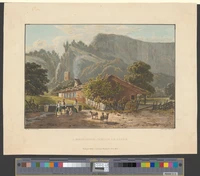
Osterwald, Rose Mille. d’, an illustrator and landscape painter in Neuchâtel, was born around 1800, and since she showed a clear inclination toward landscape painting from an early age, no further obstacles were placed in her path later on. She painted landscapes in oil, but devoted even more of her time to drawing. She provided such drawings for the Voyage pittoresque dans la Vallée de Chamouni, with text by Raoul-Rochette. Two other works, engraved from her drawings, are titled: XII. Maisons suisses dessinées d’après nature, in color; Douze chalets suisses de l’Oberland Bernois in aquatint.
Georg Kaspar Nagler, Neues allgemeines Künstler-Lexicon oder Nachrichten von dem Leben und den Werken der Maler, Bildhauer, Baumeister, Kupferstecher, Formschneider, Lithographen, Zeichner, Medailleure, Elfenbeinarbeiter etc., Volume 10, Munich 1841, p. 417
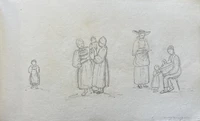
Thanks to a surviving sketchbook by Rose d’Ostervald, we gain insight into the artist’s creative process: Around the year 1820, the artist traveled to the Bernese Oberland and meticulously studied the local peasant women at work, as well as in their interactions with their children. Rose d’Ostervald filled countless pages of her sketchbook in this way, taking care to capture the women from different perspectives and in various poses. She used these sketches later in her studio to incorporate the figures into 12 views of chalets in the Bernese Oberland. Her finished drawings were subsequently engraved by artists such as Johann Jakob Falkeisen, Sigismond Himely, and Friedrich Salathé, and were published around 1827 as an album titled "Douze chalets suisses de l’Oberland Bernois" by the publisher and art dealer Henri Rittner (1802–1840) in Paris.
Rose d'Ostervald: Europe-wide recognition
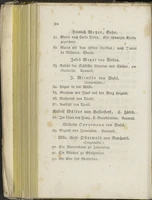
Rose d'Ostervald was known to be married to the Zurich-based Johann Jakob Horner (1772–1831), who was active in the Zurich Artists’ Society for many years and served, among other roles, as its secretary. A letter that Rose d’Ostervald wrote to Johann Jakob Horner on July 23, 1824, reveals that the artist had exhibited works for the first time at the Artists’ Society’s annual exhibition in May of that same year. According to Horner, these works were very well received by the Artists’ Society, and he encouraged the artist to submit works for the exhibition again the following year. As evidenced by the excerpt from the 1825 exhibition catalog shown here, Rose d’Ostervald complied with this request and exhibited three oil paintings featuring Swiss landscapes and genre scenes at the 1825 exhibition. This made the Neuchâtel-born artist the only woman to exhibit her works that year alongside numerous well-known minor masters.
Rose d’Ostervald was very successful at this time: She exhibited her works not only in Zurich, but also in Geneva in 1823 at the Salon of the local artists’ society, in Paris in 1831 at the Salon of the Musée royal des arts, and in Berlin in 1826, 1828, and 1830 at the official Salon of the Prussian court. Unfortunately, Rose d’Ostervald died at the age of 34—her biographers later attributed to her what would have been a promising career as an artist.
Zurich Artists' Society, Catalogs of Art Exhibitions in Zurich from 1799 to 1838, Zurich 1825, p. 10, https://digital.kunsthaus.ch/viewer/image/49705/ [March 16, 2026]; Rose d’Ostervald, letter to Johann Jakob Horner (1772–1831) dated July 23, 1824, manuscript, Zurich Central Library, Ms M 8.42, https://uzb.swisscovery.slsp.ch/permalink/41SLSP_UZB/g8duei/alma990000870290505508 [March 16, 2026]
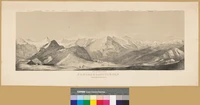
Franziska Möllinger: A Pioneer in Photography
Franziska Möllinger, who was born in Speyer, Germany, Franziska Möllinger (1817–1888) demonstrated a strong spirit of discovery: In Solothurn, she experimented with her brother, Otto Möllinger, using the then-new photographic technique of daguerreotype. Beginning in 1839, Franziska Möllinger offered portrait photography and developed Swiss cityscapes and landscapes that she had captured while traveling through Switzerland. It is not known what kind of education Franziska Möllinger received. Otto Möllinger was a professor of mathematics and physics in Solothurn and, beginning in 1839, published articles on daguerreotype and its technical developments. The siblings’ collaboration resulted in some of the earliest Swiss vedute based on photographic originals that have survived to this day.
The process developed in 1839 by Louis Daguerre (1787–1851) made it possible, for the first time in the history of landscape representation, to capture the world through a purely mechanical and chemical process. In the early years of daguerreotype use, the chemically prepared plates had to be exposed—that is, left in the light—for a very long time inside the camera, which made the process cumbersome and difficult to control. This makes the work by Franziska Möllinger shown here all the more remarkable: The Faulhorn panorama consists of several individual shots that the photographer took on site, slightly overlapping one another. The exposed plates were then developed in a darkroom and served as a lifelike template for transferring the panorama into a drawing and subsequently (or directly) onto a lithographic stone. It was only through this transfer to the printmaking medium that the daguerreotype could be reproduced and sold in large quantities.
René Perret, With Inimitable Fidelity: The Daguerreotype in German- and Southern Switzerland, in: From Nature. Swiss Photography in the 19th Century, ed. by Martin Gasser and Sylvie Henguely, Göttingen 2021, pp. 76–115, here: pp. 84–85
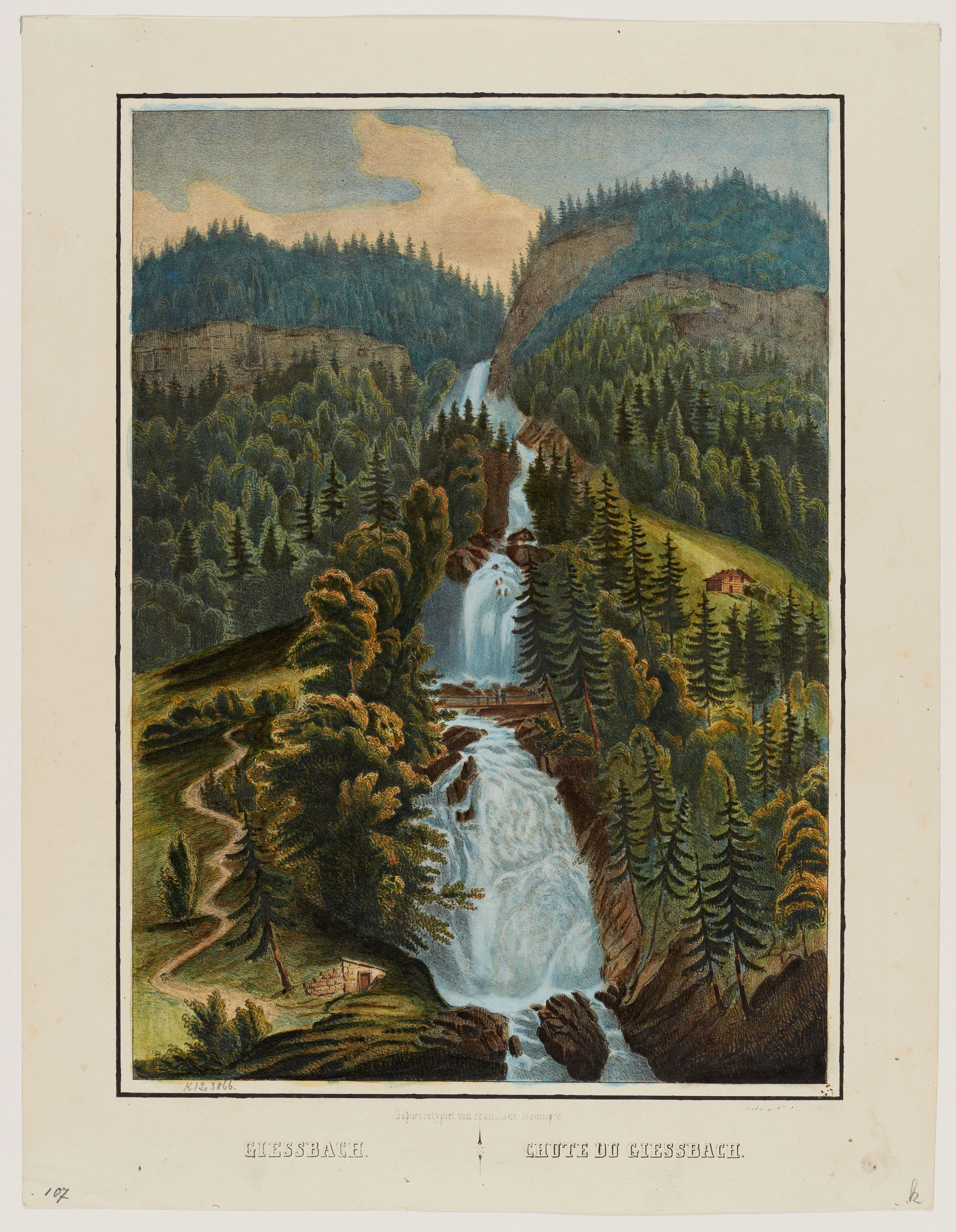
Franziska Möllinger: On the Road to the Hotspots
Franziska Möllinger was long regarded as a so-called “amateur.” However, it is important to bear in mind that the field of photography was just beginning to develop around 1840 and had not yet become an established profession. In this sense, she was certainly a professional photographer pursuing an ambitious photographic project. This project was reported in the Neue Zürcher Zeitung on May 2, 1844:
The same [brochure] announces “Daguerreotype Views of the Capital Cities and the Most Beautiful Regions of Switzerland, by Franziska Möllinger,” in 30 installments of 4 sheets (for subscribers at 4½ Batzen per sheet). Certainly an undertaking that, if successful, every Swiss will rejoice in. The prospectus itself states: “Each view is 10'' 6''' long and 8'' 2''' high and has been executed with the utmost care—both in terms of shape and outline as well as in regard to light and shadow—based on several original silver plates depicting one and the same area, which were produced using a large and excellent Voigtländer camera, drawn at double scale and executed with the finest chalk-style detail, so that all these views, mounted in glass and frames, can be hung as paintings to adorn even the most beautifully decorated rooms. It goes without saying that such a collection is unique in its kind, and none of the collections of Swiss subjects published to date can even remotely compare to it; for that perfect perspective and lighting, as captured on daguerreotype plates, is—as is easy to understand—unattainable even for the most accomplished artist.”
Neue Zürcher Zeitung, Issue 123, May 2, 1844, p. 491
What was heralded as a major innovation appears to have met with little success: Of the 120 views announced for the album “Daguerreotype Views of the Capital Cities and the Most Beautiful Regions of Switzerland,” only 15 sheets were published—the image shown here of the famous Giessbach Falls in the Bernese Oberland was sheet 11. Was the project too labor-intensive and too expensive? Did customers still prefer engraved views? Did Franziska Möllinger lack sufficient commercial ambition? Were there disagreements with the lithographers? Since very few sources are known that provide information about Franziska Möllinger and her work, these questions remain (for now) unanswered. Even though the project was never completed, the Solothurn-based photographer’s initiative represented truly pioneering work.
René Perret, In unnachahmlicher Treue. Die Daguerrotypie in der Deutsch- und Südschweiz, in: Nach der Natur. Schweizer Fotografie im 19. Jahrhundert, ed. by Martin Gasser and Sylvie Henguely, Göttingen 2021, pp. 76–115, here: pp. 77–78
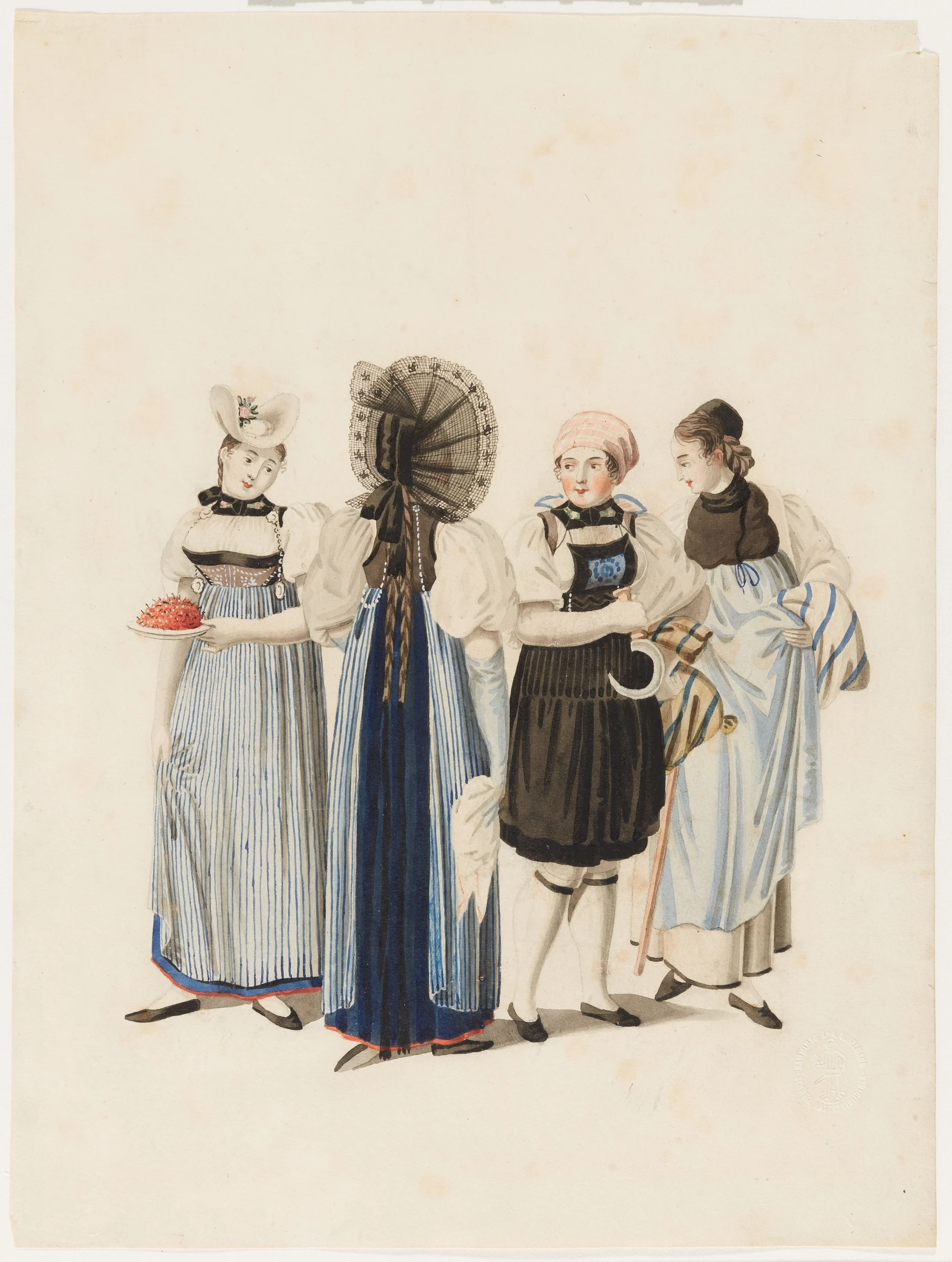
Elise Wysard-Füchslin: The Traditional Costume Specialist
We do not know much about Elise Füchslin, who was born in 1790 or 1791 in Brugg in what is now the canton of Aargau, as very few sources document her life and work as an artist. She acquired her double surname through her marriage in 1815 in Biel to Gottlieb Emanuel Wysard (1798–1837). The painter and etcher, who was originally from Bern, had specialized in depictions of traditional costumes. It appears that he had made a name for himself particularly among English travelers: His works are found remarkably frequently in English collections today, such as the British Museum. During their marriage, Elise Wysard-Füchslin worked in her husband’s studio, presumably as a draftswoman and colorist.
When the couple divorced in 1823, Elise’s artistic skills were essential to her survival: They enabled her to build an independent life for herself—free from her ex-husband, who shortly thereafter was placed under the care of a guardian due to “mental illness.” Elise moved to Bern and continued her work as an artist there. From then on, she often signed her traditional costume paintings “Madame Wysard à Berne.” This was a stroke of luck for posterity: it allows us to clearly identify her own works as well as those produced based on her designs, and it introduces us to yet another female artist who made her mark among the Swiss “Little Masters.”
Werner Bourquin, Marcus Bourquin, and Werner Hadorn. Biel. Stadtgeschichtliches Lexikon von der Römerzeit (Petinesca) bis Ende der 1930er Jahre. Historisch, biographisch, topographisch: mit Ergänzungen für den Zeitraum bis 2007. 2nd ed. Biel 2008, pp. 495–496; https://www.biel-bienne.ch/de/elise-wysard-fuechslin.html/3448#8%20Wysard%20d%20ebd [December 9, 2025]
Researching Swiss Women Artists
"Seek and you shall find." – a fitting conclusion to this showcase on the women artists associated with the Kleinmeister. Because social conditions around 1800 made it considerably more difficult for women to train as artists, to work in nature, and to market their works commercially – and because female artists have generally received little attention in art history – they are significantly outnumbered by their male counterparts in the historical record – and yet they existed. They carved out or fought for various positions within the art world and made an important contribution to the creation, dissemination, and technical development of the "Images of Switzerland". In recent years, awareness of their history has increased markedly thanks to various institutional and artistic initiatives. It is our task today to continue following the traces left behind by these female artists and thereby foster a new, nuanced understanding of their presence and significance in Switzerland.
Barbara Dieterich, Jochen Hesse, Anna Lehninger, and Alice Robinson-Baker, In Frauenhand: Künstlerinnen aus fünf Jahrhunderten = In her hand: five centuries of women artists. Zurich Central Library, 2025; SIKART Focus: Modern Women Artists, https://recherche.sik-isea.ch/de/everything/on/sikart?ui.featured=cms:news_30d8fc59-5d29-4769-ab42-3625e8e862bc [March 16, 2026]; Hulda Zwingli (fictional character and collective), https://www.instagram.com/huldazwingli/ [March 16, 2026]